




언론보도
새소식
협회소식
언론보도
K-Beauty Industry Launches AI-Driven Fight Against Counterfeits Led by…
작성자 TIPA
작성일 26-01-23 14:09
조회수 4
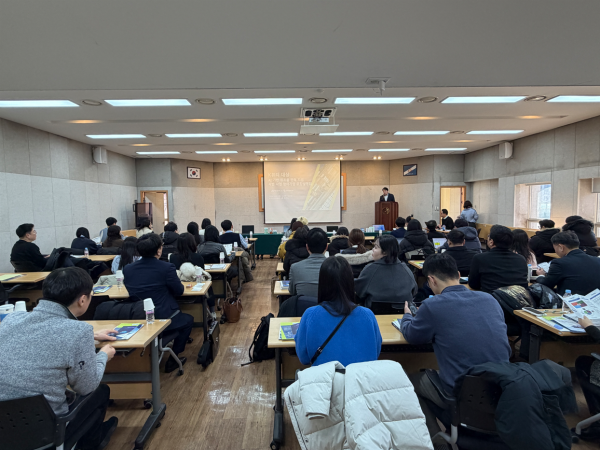
An information session for the “AI-Based Intellectual Property Verification Support Pilot Project,” jointly organized by TIPA and Pinocchio Lab, marks the launch of the AI verification pilot program for the K-beauty industry.
Photo = TIPA
The K-beauty industry has launched a new battle against counterfeit goods by introducing what is believed to be the world’s first rights-holder-led artificial intelligence (AI) verification technology.
An information session for the “AI-Based Intellectual Property Verification Support Pilot Project,” jointly organized by the Trade-related Intellectual Property Rights Protection Association (TIPA) and Pinocchio Lab, was recently held, marking the official launch of the AI verification pilot program targeting the K-beauty industry.
According to TIPA on the 27th, the briefing began with welcoming remarks by Hyuk-kyu Kwon, Head of the Management Planning Department at TIPA.
“Today marks the beginning of a new era in which rights holders themselves can identify counterfeit products using advanced technology,” he said, emphasizing the significance of the pilot project.
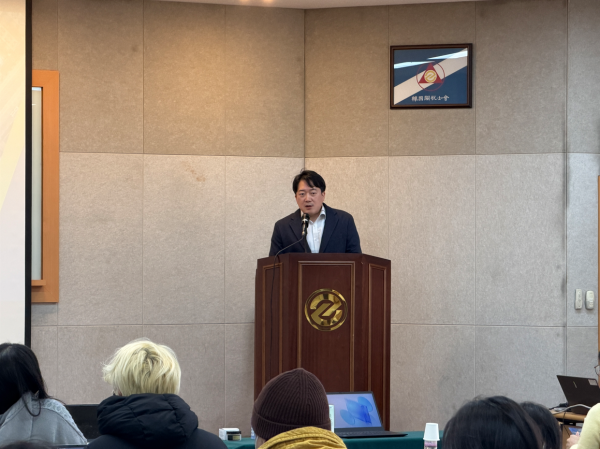
Hyuk-kyu Kwon, Head of the Management Planning Division at TIPA, delivers welcoming remarks.
Photo = TIPA
During the event, Young-seop Seo, Director of the Intellectual Property Protection Support Department at TIPA, explained the background and overview of the pilot program as well as the overall intellectual property protection system at the customs clearance stage. He also introduced the objectives and operational plan of an AI verification model specifically designed for the K-beauty sector.
Seo highlighted cases of damage suffered by the K-beauty industry due to counterfeit cosmetics, noting that “by integrating advanced AI technology into on-site inspections and verification processes, it will be possible to reduce the burden on rights holders and significantly improve response efficiency.”
Through the pilot project, TIPA plans to gradually verify the practical applicability of AI verification technology in the field and develop a technology-driven intellectual property protection support model for combating counterfeit goods.
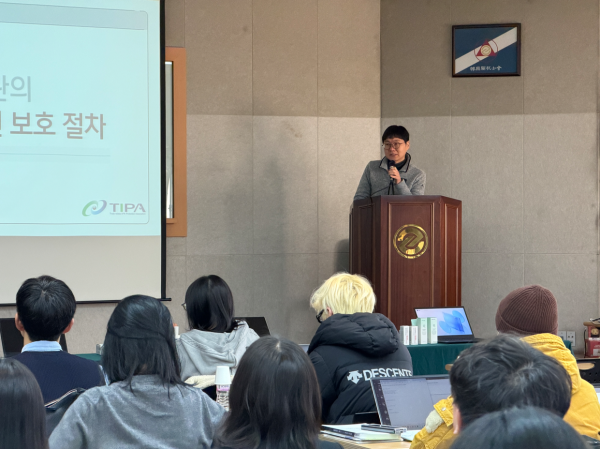
Young-seop Seo, Director of the Intellectual Property Protection Support Department at TIPA, explains the intellectual property protection system at the customs clearance stage.
Photo = TIPA
Ji-yeon Lee, Head of Strategic Planning Team, then provided a detailed explanation of the project’s background and the future direction for AI technology advancement. She presented the reasons why rights-holder-led counterfeit verification is necessary in the K-beauty sector and outlined the technology development roadmap.
“By combining the expertise of rights holders with cutting-edge AI technology, we aim to continuously improve verification accuracy,” Lee said.
She also introduced a new protection strategy in which rights holders can directly utilize AI verification results to assist domestic and international enforcement and investigations, while ensuring that sensitive information is not disclosed publicly and is shared only with investigative authorities.
This approach allows rights holders to retain control over counterfeit determinations while safeguarding confidential brand information, drawing positive responses from participants at the event.
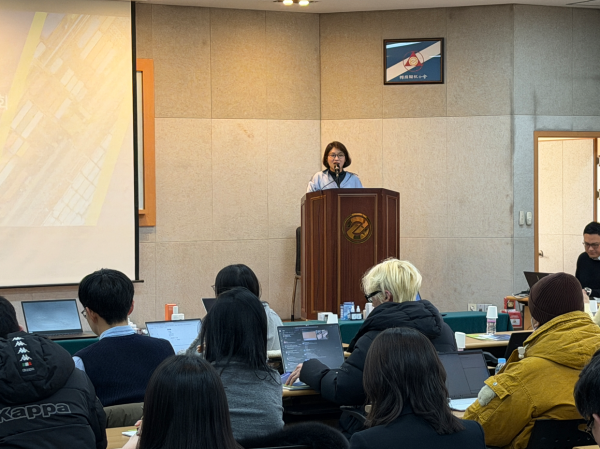
Ji-yeon Lee, Head of the Strategic Planning Team at TIPA, presents the project background and AI development roadmap.
Photo = TIPA
The AI-based counterfeit verification technology jointly developed by TIPA and Pinocchio Lab was first unveiled on October 2 last year at the “Counterfeit Verification Technology Conference” hosted by the Ministry of Intellectual Property.
At the conference, Hyuk-kyu Kwon introduced the structure, key functions, and application scenarios of the AI-based TIMS system, presenting operational strategies that could be utilized by government agencies, K-brand companies, and distributors.
A live demonstration was also conducted at the conference using K-beauty products and automotive parts to showcase the identification of counterfeit goods. As K-beauty products—one of Korea’s major export categories—were included in the demonstration, attendees were able to directly witness the effectiveness of counterfeit detection technology and its potential impact on consumer safety.
At the latest briefing session, TIPA and Pinocchio Lab also conducted a live demonstration of the AI verification technology using actual K-beauty products.
During the demonstration, the AI system analyzed images of genuine and counterfeit cosmetics and immediately determined their authenticity. Developers showed how a smartphone application can capture product images, after which the AI detects subtle differences and delivers verification results.
Representatives from K-beauty brands attending the event tested the application themselves, experiencing firsthand the technology’s accuracy and convenience. Many participants expressed admiration as the AI system distinguished counterfeit products from genuine ones in real time.

Representatives from TIPA and Pinocchio Lab demonstrate AI verification technology using actual products.
Photo = TIPA
Numerous K-beauty companies attending the session expressed their intention to participate in the pilot project and voiced strong expectations for the new technology.
A representative from a mid-sized cosmetics brand stated, “Counterfeit versions of our products are increasing both online and offline in domestic and overseas markets. If AI verification technology is introduced, it could be widely used in enforcement, verification, and investigations.”
Participants also responded positively to the system’s ability to allow rights holders to secure verification results themselves and provide them to investigative authorities while keeping the information confidential.
This mechanism enables effective cooperation with enforcement authorities without disclosing sensitive information publicly, offering rights holders a practical tool to address damages caused by counterfeit goods.
In closing, Ji-yeon Lee stated, “Through this pilot project, we aim to establish a new protection model for K-beauty led by rights holders and proactively block the distribution of counterfeit goods using AI technology. We will also actively pursue collaboration with related institutions and organizations in the future.”
TIPA plans to expand intellectual property protection strategies that combine innovative technologies with public-private cooperation across various industries, including K-beauty.
Through these efforts, the organization aims to take the lead in building a healthy intellectual property ecosystem free from counterfeit goods.